Key Takeaways
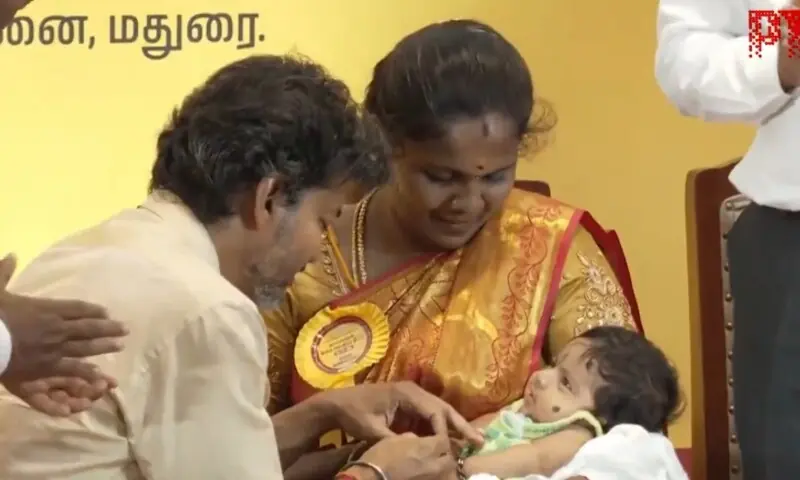
- Tamil Nadu state in India launched a scheme to give newborns a one-gram gold ring.
- The initiative aims to boost confidence in public healthcare and highlight maternal care.
- Critics argue that essential nutrition is more urgent than a gold ring for families.
Authorities in India’s Tamil Nadu state have initiated a unique program, distributing a one-gram gold ring to every newborn born in government-run hospitals. The scheme, launched by actor-turned-Chief Minister Vijay, aims to enhance public trust in the healthcare system and underscore the importance of maternal and newborn care.
The gold ring, valued at approximately $143, is part of a broader cultural significance in India, where gold is deeply embedded in traditions and seen as a secure generational asset. A mother from Madurai district, who preferred to remain anonymous, expressed her gratitude, saying, 'The gold ring would give the child something valuable to keep for the years ahead.'
The initiative has received mixed reactions. While many mothers are appreciative, opposition party member Tamilisai Soundararajan criticized the scheme, stating, 'A gold ring for a newborn may be a welcome gesture, but for families, the most immediate need is ensuring that essential nutrition is available every day.'
India’s public hospitals often face challenges such as staff shortages, long waiting times, and inadequate infrastructure, leading many to opt for private healthcare services. Despite these issues, the majority of women in India still give birth in hospitals, making institutional childbirth a priority for health authorities.
Despite progress, infant and maternal mortality rates remain high in India. The latest official data shows 24 infant deaths per 1,000 live births and 88 maternal deaths per 100,000 live births. The gold ring scheme, known as the ‘Thaimaman’ (maternal uncle) programme, draws on the cultural significance of a child’s maternal uncle, who traditionally plays a significant role in family celebrations.
The scheme also taps into India’s enduring love for gold, with the country being one of the world’s largest consumers of the metal. According to the World Gold Council, demand in India reached $25 billion in the first quarter of this year, highlighting the cultural and economic importance of gold in the nation.
While the initiative is seen as a positive step towards boosting public confidence in healthcare, it also raises questions about the allocation of resources. Critics argue that addressing immediate nutritional needs of families should take precedence over such symbolic gestures.
The Tamil Nadu government hopes that this scheme will not only provide a tangible benefit to newborns but also serve as a symbol of the state’s commitment to maternal and child health.
The gold ring would give the child something valuable to keep for the years ahead.
A mother from Madurai district, Mother
A gold ring for a newborn may be a welcome gesture, but for families, the most immediate need is ensuring that essential nutrition is available every day.
Tamilisai Soundararajan, Opposition party member