Key Takeaways
- Finance Minister Muhammad Aurangzeb announced plans to reduce human intervention in tax administration through AI.
- Pakistan is preparing to issue more Eurobonds and sukuk, with strong demand for previous issuances.
- The banking industry plays a crucial role in Pakistan’s economic growth, contributing significantly to government revenues.
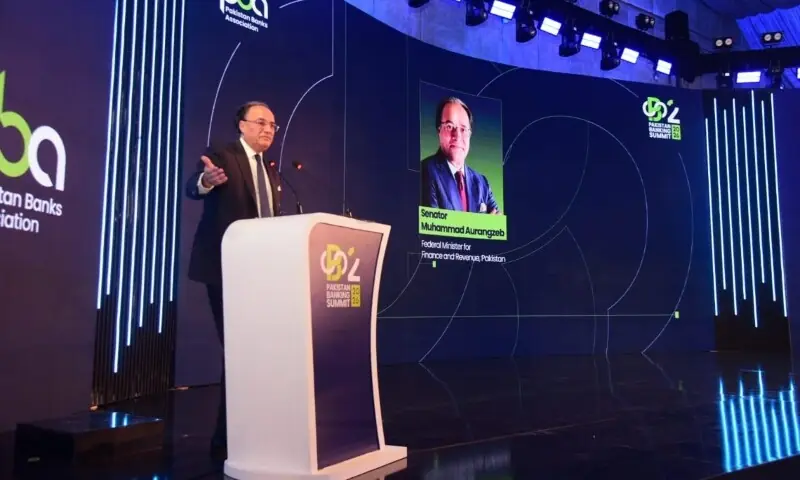
Finance Minister Muhammad Aurangzeb has outlined plans to integrate artificial intelligence (AI) into the tax administration process, aiming to minimize human intervention. Speaking at a banking summit in Karachi on Tuesday, Mr Aurangzeb stated that notices would be issued through AI-led systems under the new operating model approved by parliament.
The minister highlighted several key initiatives, including the successful issuance of Panda Bonds in mid-May 2026, which attracted demand five times its target. This achievement has paved the way for Pakistan to prepare for future international bond issuances, particularly Eurobonds and sukuk, with a focus on dollar-settled rupee-linked bonds.
Mr Aurangzeb expressed optimism about the upcoming bond issues, noting that strong investor demand would support these new financial instruments. He also thanked the prime minister and cabinet for their role in re-entering the international bond market after four years. The government plans to issue requests for proposals to assess market demand and pricing.
The banking industry was discussed at length during the summit, with Zafar Masood, Chairman of the Pakistan Banks Association, emphasizing its critical role in the economy. Mr Masood highlighted significant growth in credit lending, particularly to agriculture (39% increase within a year) and housing (90% increase). SMEs also benefited from increased lending, with growth rates reaching 111% per year.
Mr Aurangzeb further elaborated on the budget, which was led by the Tax Policy Office for the first time. The focus of the budget included export-led growth, removal of advance tax and super tax, low-cost subsidised financing, and continuation of the tariff regime. He thanked the prime minister and cabinet for their support in these initiatives.
The finance minister also addressed the importance of increased lending to various sectors, including SMEs, exporters, agriculture, manufacturing, construction, and IT. He acknowledged that while progress has been made, there is still a long way to go towards sustainable growth. The banking industry was highlighted as essential for Pakistan’s journey from stabilisation to sustainable growth.
The minister concluded by thanking the prime minister and cabinet for their support in these initiatives. He emphasized the critical role of the banking sector in driving economic activity and generating significant tax revenues, noting that banks paid over Rs1 trillion annually to the government.
We focused on export-led growth, removing the advance tax, removing the super tax, low-cost subsidised financing and continuing with the tariff regime.
Muhammad Aurangzeb, Finance Minister
Credit lending to agriculture had increased by 39 per cent within a year, while housing lending rose by 90pc.
Zafar Masood, Chairman of the Pakistan Banks Association