Key Takeaways
- OpenAI has released the GPT-5.6 family of AI models.
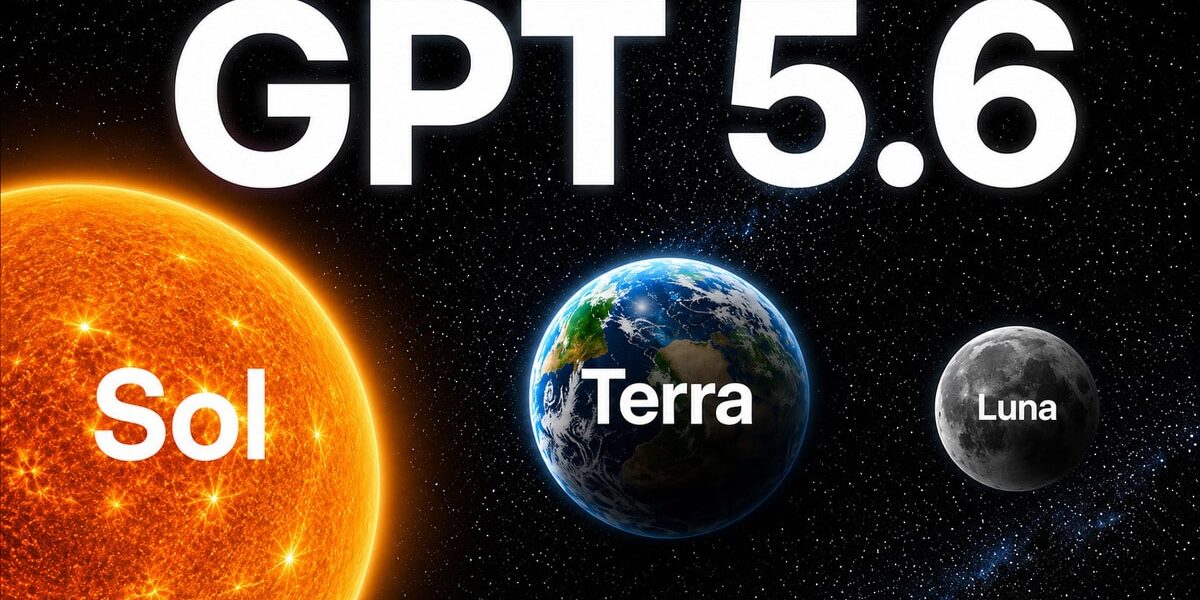
- The new lineup includes GPT-5.6 Sol, Terra, and Luna for different use cases.
- GPT-5.6 Sol is designed for high-performance tasks while Luna offers affordability.
OpenAI has officially launched the GPT-5.6 family of AI models, introducing three new variants—GPT-5.6 Sol, GPT-5.6 Terra, and GPT-5.6 Luna. These models are now rolling out across ChatGPT, Codex, and the OpenAI API, with global availability expanding over the next 24 hours.
The new lineup is designed to improve coding, reasoning, knowledge work, cybersecurity, scientific research, and computer use while offering better performance and efficiency. Each model in the GPT-5.6 family targets different use cases: GPT-5.6 Sol for high-performance tasks, GPT-5.6 Terra as a balanced option for everyday tasks, and GPT-5.6 Luna for affordability.
According to OpenAI, GPT-5.6 Sol establishes new performance benchmarks across coding, professional knowledge work, cybersecurity, and scientific research while using fewer tokens than previous models. This results in stronger performance per dollar by reducing the total cost required to complete complex tasks. The company has also introduced two advanced reasoning modes: max mode for giving the model more time to reason through difficult problems, and ultra mode for coordinating four AI agents in parallel to complete demanding tasks more quickly.
GPT-5.6 Sol is described as OpenAI's strongest coding model to date. It achieves state-of-the-art performance on several independent coding benchmarks while reducing token usage, execution time, and operating costs compared with previous models. The GPT-5.6 family can also write and execute lightweight programs, coordinate external tools, process intermediate results, monitor progress, and determine the next step automatically. Developers can use these capabilities through Programmatic Tool Calling in the Responses API.
Beyond software development, GPT-5.6 improves professional knowledge work by creating polished presentations, documents, spreadsheets, and interactive visualizations. The model can also inspect rendered outputs, identify visual issues, and refine designs before delivering completed work. OpenAI has provided detailed performance evaluations for each model in the GPT-5.6 family, comparing them against previous models like Claude Fable 5, Claude Opus 4.8, Gemini 3.1 Pro Preview, and others.
The new AI models offer improvements across coding and knowledge work. For example, GPT-5.6 Sol achieves an Artificial Analysis Coding Agent Index of 80 compared to 77.4 for GPT-5.6 Terra and 74.6 for GPT-5.6 Luna. In the SWE-Bench Pro benchmark, GPT-5.6 Sol scores 64.6%, while GPT-5.6 Terra scores 63.4% and GPT-5.6 Luna scores 62.7%. These enhancements are expected to benefit developers and professionals in various fields.