Key Takeaways
- Apple's new Mac Minis and Mac Studios are cheaper than renting data centers for AI tasks.
- The devices are designed to handle complex AI tasks locally, reducing costs for businesses.
- Apple aims to compete with Microsoft and Nvidia in the enterprise desktop market.
Apple has launched new Mac Minis and Mac Studios, positioning them as cost-effective alternatives to renting data centers for AI tasks. The devices are expected to compete directly with new desktop machines from Nvidia and PC makers, which will be highlighted in a Microsoft event in San Francisco next month.
Apple's chief hardware officer, Johny Srouji, emphasized the cost benefits of the new Macs, stating, 'Once you have the machine on your desk, you’ve paid for it. And I believe we provide absolutely great value, not only in terms of performance, but cost.'
The new Macs are aimed at more intense AI tasks such as writing code or carrying out complex business work, allowing users to avoid paying for 'tokens' — the fundamental unit of AI computing — from cloud leaders like OpenAI or Anthropic.
Apple has found itself in a strong position for AI desktops thanks to its longstanding obsession with saving power. When Apple rolled out its first Apple Silicon chips in 2020, it took two kinds of chips — computing and memory — that were separate in PCs and crammed them together in a unified memory architecture for better battery life.
This close connection between computing and memory, which Nvidia and others have only recently shifted toward, had the side effect of making Macs good at AI. Apple started selling out of Mac Minis as OpenClaw, an open-source agentic AI tool, took off in markets such as China.
While Mac Studios were initially aimed at content creators editing videos or music, Apple has quietly slipped in exotic AI features, such as bespoke chip-to-chip networking called RDMA over Thunderbolt, over the past two years.
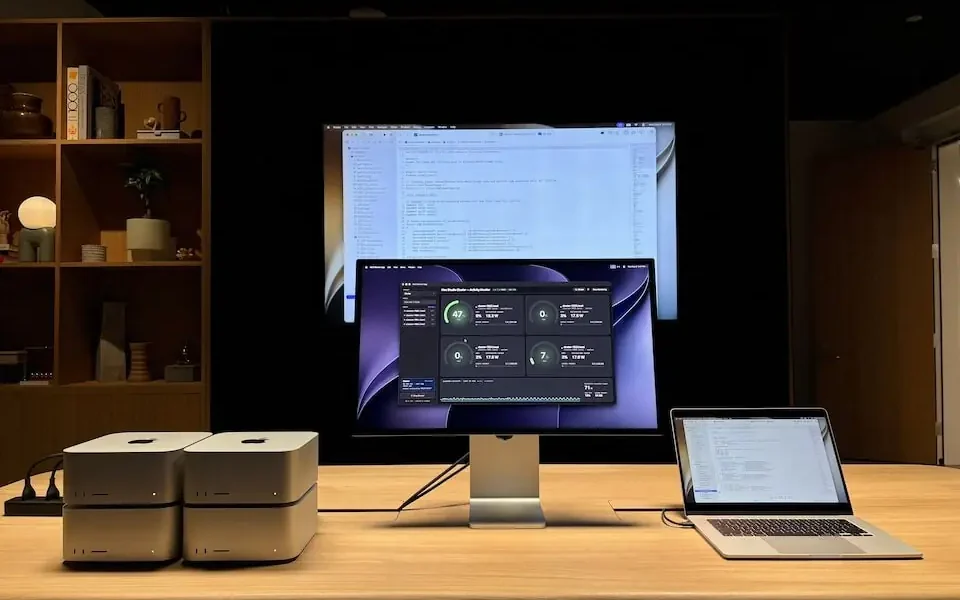
Apple demonstrated four Mac Studios running an AI model with a trillion parameters to find and fix a graphics coding bug. Such tasks usually require a data center, but the stack of Macs runs off one wall outlet, making them a viable alternative for businesses.
Microsoft is also chasing the same market for what CEO Satya Nadella calls 'unmetered intelligence' of on-device AI. Nadella has said Microsoft plans to roll many of its AI features into a 'super app' for Windows, but Microsoft's historic first place in corporate computing means supporting hardware from a huge range of vendors, which can create more work for Windows developers looking to get the most out of the platform.
Apple's new Macs are a significant challenge to Microsoft's dominance in the enterprise desktop market, which IDC's Linn Huang reports as 91.3% for Windows versus 4.6% for Apple.
Once you have the machine on your desk, you’ve paid for it. And I believe we provide absolutely great value, not only in terms of performance, but cost.
Johny Srouji, Apple’s chief hardware officer