Key Takeaways
- WD 1856 b is the only known planet to have survived its star's death.
- The James Webb Space Telescope provided new insights into this unique planetary system.
- This discovery challenges our understanding of how planets interact with their stars.
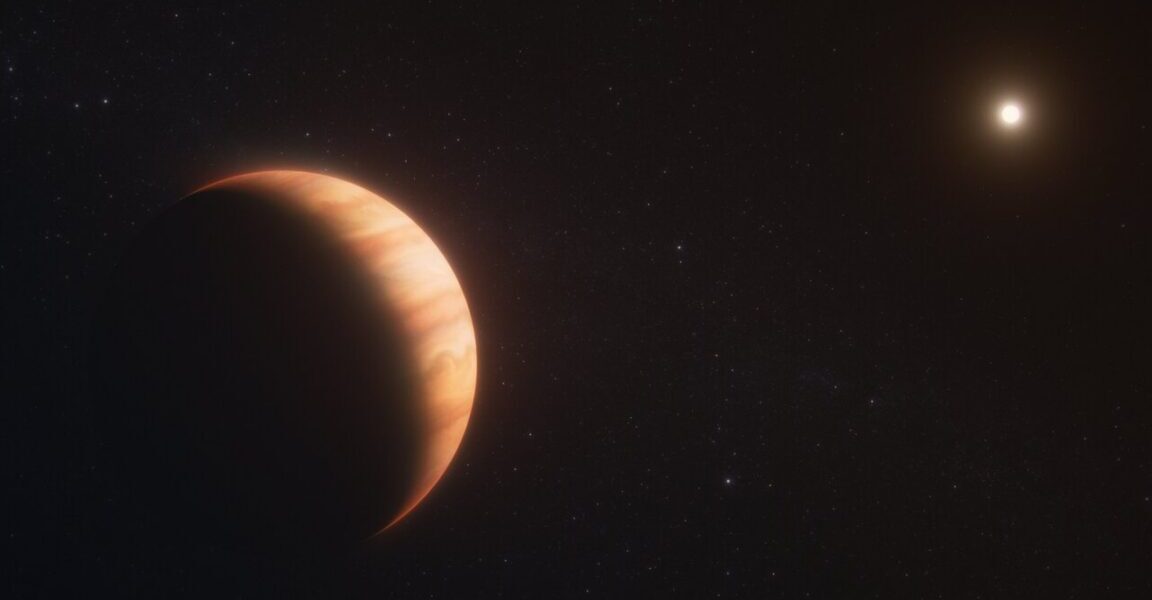
Astronomers using the James Webb Space Telescope (JWST) have made a groundbreaking discovery, confirming that WD 1856 b is not only the sole known planet to have survived its star's death but also the first Jupiter-sized world orbiting a white dwarf. This finding challenges existing theories about planetary survival in such extreme environments.
The initial detection of WD 1856 b was an accidental discovery made by the Transiting Exoplanet Survey Satellite (TESS) in 2020. TESS astronomers were surveying approximately 2,000 white dwarfs for signs of transiting objects like comets or asteroids. However, what they found in the WD 1856 system was a gas giant planet, which O’Connor described as “weird” upon first observation.
Christopher O’Connor, a theoretical astrophysicist at Cornell University and co-author of the recent Nature study on WD 1856 b, explained that this discovery is particularly intriguing because white dwarfs are remnants of Sun-like stars that have exhausted their nuclear fuel. These stars typically leave behind an Earth-sized core composed mainly of carbon and oxygen. The presence of a Jupiter-sized planet orbiting such a star suggests a complex interaction between the two.
The James Webb Space Telescope’s observations provided new data on WD 1856 b, revealing that it orbits extremely close to its white dwarf host, at just one-tenth the distance from Earth to the Sun. This proximity raises questions about how the planet managed to avoid being consumed by the star during its red-giant phase.
The discovery of WD 1856 b challenges our understanding of planetary systems and their evolution. It suggests that planets can survive in environments previously thought inhospitable, potentially offering new insights into the long-term stability of exoplanets.
Further research is needed to understand the mechanisms by which such a planet could have survived its star's death. O’Connor noted that this discovery opens up new avenues for studying planetary systems and their interactions with stellar remnants.
As soon as they looked at it, they said, okay, that’s weird.
Christopher O'Connor, Theoretical astrophysicist at Cornell University