Key Takeaways
- Geologists propose that intense asteroid bombardments melted the early Earth's crust, allowing for continental formation.
- The oldest known rocks date back to around 4.03 billion years ago, providing limited evidence for scientists.
- Tim Johnson from Curtin University suggests this bombardment was crucial in creating buoyant continents.
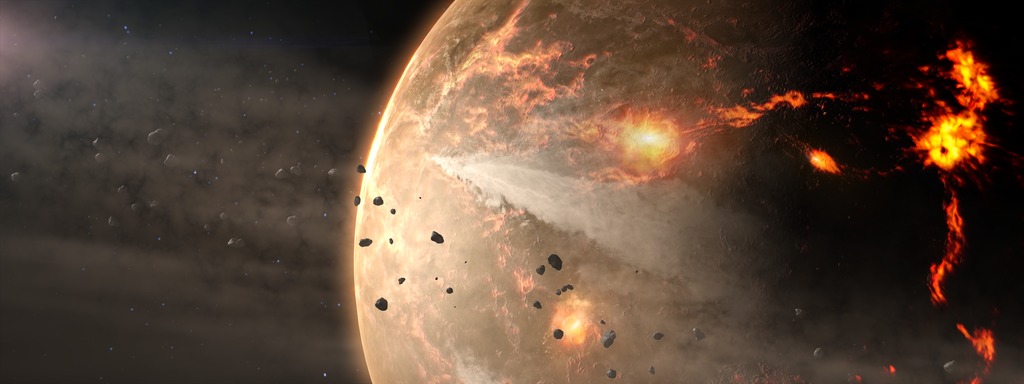
Geologists at Curtin University in Perth, Australia, have proposed a new theory that the early Earth's continental crust was formed due to intense asteroid impacts. According to Tim Johnson, a geologist involved in the research, these cosmic bombardments kept the early Earth’s crust hot and thin enough for buoyant continents to emerge.
The formation of continents on Earth remains one of the most significant mysteries in geological science. The oldest known continental-type rocks date back only 4.03 billion years, leaving a vast gap in our understanding of how these landmasses first appeared.
Johnson and his colleagues argue that this intense bombardment was not just an isolated event but a sustained process that lasted for millions of years. This theory challenges the prevailing view that continental crust formation was gradual and continuous over time.
The scarcity of geological evidence from Earth’s early history makes it difficult to study the origins of continents. The oldest zircon crystals, which are among the oldest known materials on Earth, date back only 4.4 billion years, while basaltic rocks date back around 4.2 billion years.
Despite these limitations, Johnson emphasizes that the data available is crucial for understanding the early Earth’s geological processes. 'There are huge debates about what was going on in the early Earth because the data is so scarce,' he said. The lack of evidence means scientists must rely heavily on educated guesses and theoretical models to piece together this ancient history.
The proposed theory suggests that these asteroid impacts were not only frequent but also intense, melting large portions of the early Earth’s crust. This process would have created a thin, hot layer of rock that could rise above the surrounding mantle, forming the first continents.
While the exact timing and frequency of these impacts are still subjects of debate, Johnson believes they played a crucial role in shaping the Earth as we know it today. 'The lands we live on are here because of ancient bombardment from space,' he stated, highlighting the importance of this theory in understanding continental formation.
Further research is needed to confirm or refute these findings. However, if proven correct, this theory could revolutionize our understanding of how Earth’s continents first appeared and evolved over time.
The lands we live on are here because of ancient bombardment from space.
Tim Johnson, Geologist at Curtin University